

Myth or reality
Myth: anyone can negotiate with a supplier
Procurement negotiation is not an inborn talent but a learnable profession. What professional negotiators do differently, and how to develop your team.
19 October 2026 · 5 min read
Not every supplier deserves the same treatment. The Kraljic matrix shows where to run tenders, where to manage risk and where to build partnerships.
ProcurePro 4 min read
Ask ten procurement managers how they manage their suppliers. Nine will say: strategically. Then look at how they choose an office-supplies vendor and a manufacturer of a critical component. Often exactly the same way.
This problem has had a solution since 1983. That year Peter Kraljic published “Purchasing Must Become Supply Management” in the Harvard Business Review, introducing the 2×2 matrix that is still one of the core tools of procurement strategy. We use it regularly in our procurement projects: on previously unmanaged spend it has delivered at least 5–10% savings for us, often more.
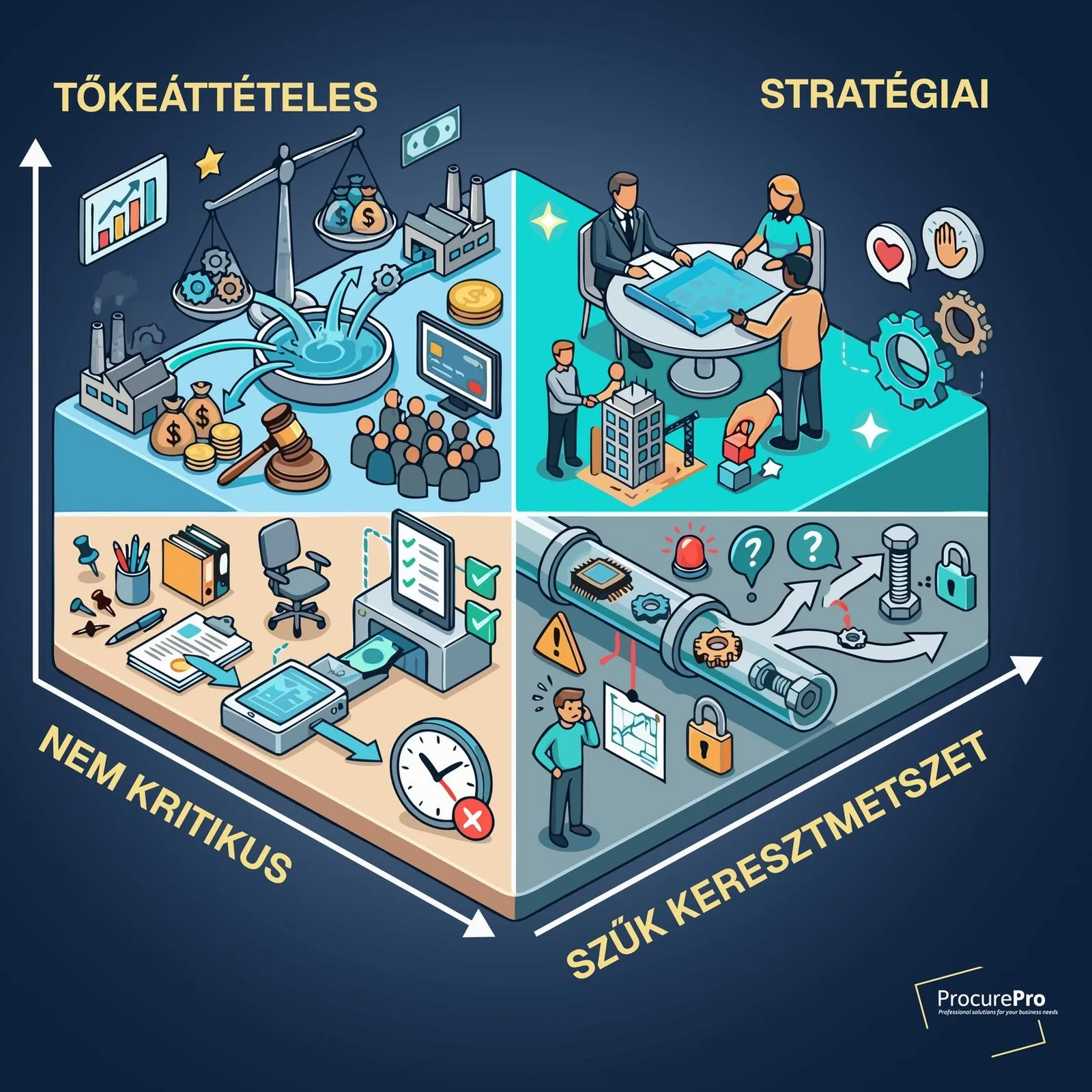
The matrix rates every purchased item on two dimensions.
Impact on business results. How much does the company spend on it, and how much does it affect product quality, profit and operations? A main raw material has high impact, cleaning supplies have low impact.
Supply market complexity, in other words supply risk. How many alternative suppliers exist, how hard is it to switch, what technology dependence is involved, how long is the lead time? If only one manufacturer can make a given part, the risk is high.
Where the two axes cross, four categories emerge, and each needs different handling.
Office supplies, cleaning products, minor maintenance materials. Many line items, low value, and suppliers can be swapped at any time.
The goal here is simplification. Fewer suppliers, framework agreements, catalog ordering, as little manual work as possible. Procurement time should not go into these items. This quadrant is the first one worth automating, which we cover in our article on AI in procurement.
High-volume, standard products that many suppliers offer at similar quality. Packaging, standard metal parts, logistics services.
In this quadrant the company’s buying power is greatest. This is where you run regular tenders, bundle volumes and negotiate firmly. The quick savings from a Kraljic analysis usually come from here.
Low-value items that are hard to source. A special seal, a custom part made by a single manufacturer. The company spends little on it, but if it is missing, the production line stops.
Price is secondary here. The goal is risk management: safety stock, finding and qualifying an alternative supplier, a longer-term agreement, or even redesigning the product so a standard part will do.
Main raw materials, key components, critical services, with few alternatives. These determine product quality and the company’s competitiveness.
The goal in this quadrant is partnership. Long-term cooperation, joint development, regular management meetings, shared risk management. A strategic supplier is not someone you re-tender every year. You grow together.
Most procurement managers know the matrix. The problem is that it doesn’t make it into daily work. Buyers walk into every supplier meeting with the same contract templates and the same negotiation approach. On leverage items they leave money on the table, and on bottlenecks they are exposed when a supplier fails.
We see three reasons most often:
A simple first round looks like this:
Open your active supplier list one morning and mark which quadrant each supplier belongs to. You will almost certainly find at least three situations that call for a different approach.
The Kraljic analysis looks simple, but a good classification takes market knowledge and experience. You need to know how many alternative suppliers really exist and what switching would cost. We run this analysis with 41 years of combined multinational procurement experience, and we carry the strategy through to implementation. See our procurement service, or request a free consultation.
For an SME, a first rough classification can be done in a working day if spend data is available. Refining it, and assessing risks and alternatives, takes further work per category.
At least once a year, and after any event that changes the market: a supplier dropping out, a new technology, a price spike, a new product launch. An item can easily move from bottleneck to strategic.
Leverage items have high spend but many available suppliers. This is where the company's buying power is greatest, so regular tenders and firm negotiation pay off.
Yes, and it often pays off faster there. Small companies have few people, so it matters even more that their limited time goes to the truly critical suppliers and not to ordering office supplies.
Myth or reality
Procurement negotiation is not an inborn talent but a learnable profession. What professional negotiators do differently, and how to develop your team.

Hackett Group's 2025 benchmark shows top procurement organizations run at lower cost and deliver more savings. What can your team take from it?

Problems and solutions
A faulty first delivery and a stopped production line. Six steps to supplier pre-qualification, from questionnaire to PPAP to contractual change control.
A free 30-minute call — then you decide. No sales process, no obligation.