

Myth or reality
Myth: anyone can negotiate with a supplier
Procurement negotiation is not an inborn talent but a learnable profession. What professional negotiators do differently, and how to develop your team.
19 October 2026 · 5 min read
Relying on a single supplier is rarely a deliberate choice. How to find your risky items, and when a qualified backup supplier is enough.
ProcurePro 5 min read
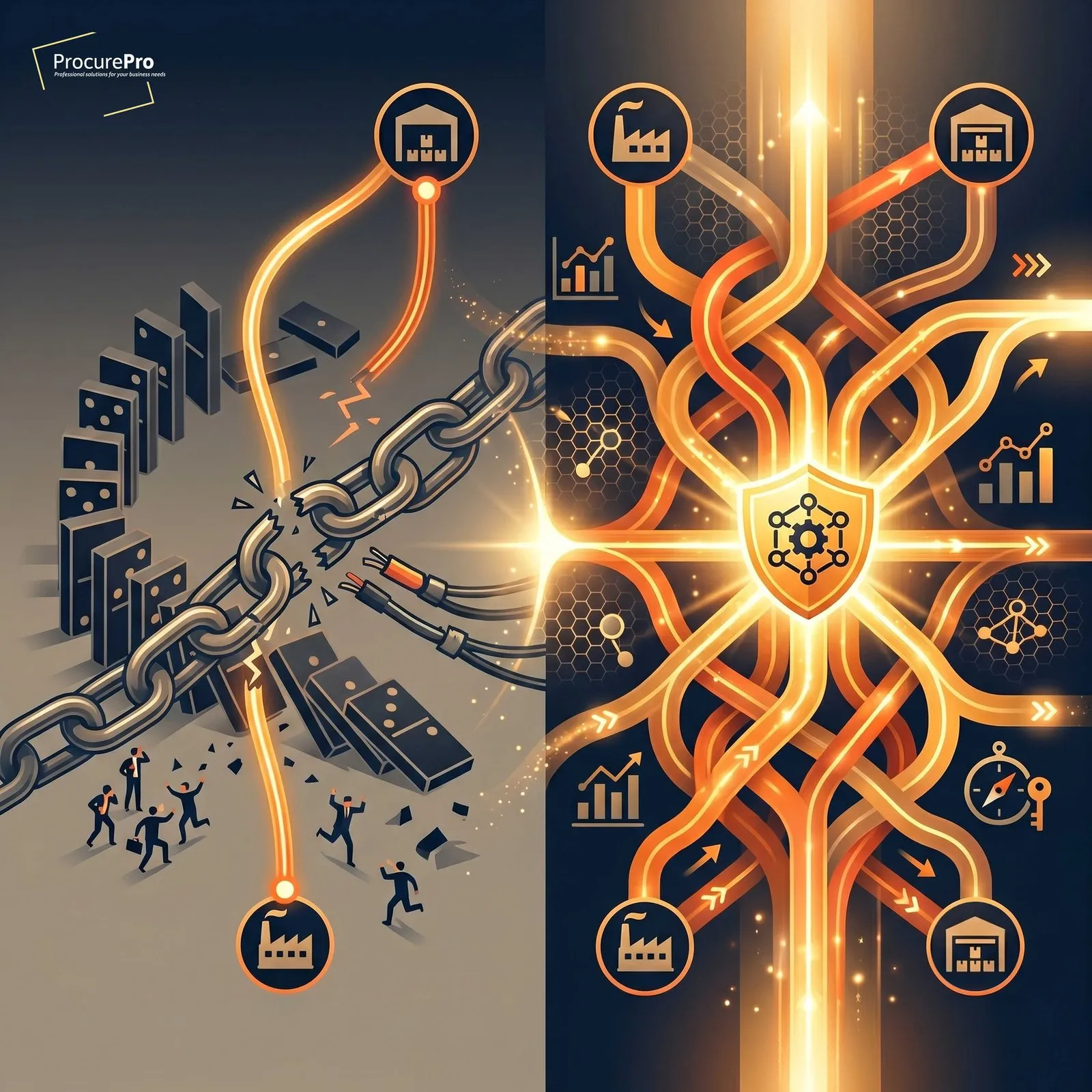
Since 2020, every business leader has seen what happens when a supplier suddenly cannot deliver. Even so, many companies in Central Europe still buy their most critical items from a single source.
This is rarely the result of a deliberate decision. It usually builds up over years, and nobody notices as long as everything works. In this article we look at where the problem comes from, how to find it in your own portfolio, and what to do about it.
When we ask in our procurement projects why a critical item has only one source, we hear almost the same answers every time:
All of these are understandable. The problem is that in none of them did anyone assess what happens if the supplier drops out.
A flood at the supplier’s site. A bankruptcy. A geopolitical event that cuts the transport route. Or simply the supplier moving capacity to a bigger customer.
On the buyer’s side, production stops, your own delivery dates slip, penalties and expedited freight costs appear, and procurement spends weeks firefighting. On top of the direct damage comes the loss of your own customers’ trust, which is hard to put a number on but lasts a long time.
One question is enough: if this supplier dropped out tomorrow, how many weeks would it take us to replace them?
Go through your active suppliers and answer it for each one. If the answer is more than four weeks, that item is a risk. Bring in engineering, because they know how long it takes to approve a new part.
Not every single-source item is equally dangerous. The Kraljic matrix helps decide where to act. In the bottleneck and strategic categories you should never rely on a single source. For non-critical items, one supplier can even be an advantage, because it means less admin.
Finding a new supplier, auditing them, producing samples and getting approval does not happen overnight. For critical parts this is typically a 12–18 month project. That is why it pays to start now, not when your current supplier has already flagged a problem.
Treat it as a real project, with an owner, a schedule and a budget. Without engineering, quality and production on board it will stall.
You do not always have to split the volume between two suppliers. In some cases a qualified backup supplier is enough: a company you do not actively order from, but whose product is approved and who could start delivering within four weeks.
This keeps the volume discount with your main supplier while still reducing the risk. Place a small trial order with the backup once a year so the approval does not go stale.
The “cheaper” single source is not cheaper once you add the expected cost of the risk. A simple estimate: how much damage would an outage cause, and how likely is it within a given period? Compare that figure with the cost of building a second source, and the decision often becomes obvious.
We cover the full-cost view in detail in our article on total cost of ownership.
Building a second source does not have to damage the relationship with your current supplier. In fact, part of the risk can be reduced together with them. In an open conversation, ask about the following:
A good supplier is happy to answer these questions, because it is in their interest too that their customer does not have to look urgently for another source.
Deliberate single sourcing is fine. If the company knows the risk, has assessed the consequences and accepts them, or has a plan for an outage, that is a legitimate business decision. Single sourcing that nobody is aware of is always a risk.
Do you know right now how many of your critical items depend on one supplier?
Assessing single-source risk starts with a review of your supplier portfolio and runs through to qualifying the second source. We do this work with 41 years of combined multinational procurement experience. See our procurement service, or request a free consultation.
With sole sourcing, only one supplier on the market can make the item, so there is no choice. With single sourcing, alternatives exist, but the company still uses one source. The second case is more common, and it can be changed.
No. For non-critical items that are easy to switch, one supplier can mean less admin and a better price. The problem starts when the item is critical and nobody knows what would happen if the supplier dropped out.
It depends on the item: samples, testing, audits, possibly tooling. Compare that cost with the damage it would cause if your current supplier could not deliver for several weeks.
Procurement leads the assessment, but engineering and production need to be part of the decision. They know the specification, and they can say how much time and work it would take to approve a new source.
Myth or reality
Procurement negotiation is not an inborn talent but a learnable profession. What professional negotiators do differently, and how to develop your team.

Hackett Group's 2025 benchmark shows top procurement organizations run at lower cost and deliver more savings. What can your team take from it?

Problems and solutions
A faulty first delivery and a stopped production line. Six steps to supplier pre-qualification, from questionnaire to PPAP to contractual change control.
A free 30-minute call — then you decide. No sales process, no obligation.