


Myth or reality
Myth: anyone can negotiate with a supplier
Procurement negotiation is not an inborn talent but a learnable profession. What professional negotiators do differently, and how to develop your team.
19 October 2026 · 5 min read
Nobody reads a 50-page process description. SIPOC shows a process on one page in five columns. How to build one, and what to use it for.
ProcurePro 5 min read
Describing a process is hard. Nobody reads a 50-page process description. A detailed flowchart is often understood only by the person who drew it. So where is the middle ground?
We think it is SIPOC. It is a one-page, five-column template that fits almost any process. In a well-prepared meeting it takes about 30 minutes to build, and from then on everyone understands the process the same way. It is one of the core tools of our process development work.
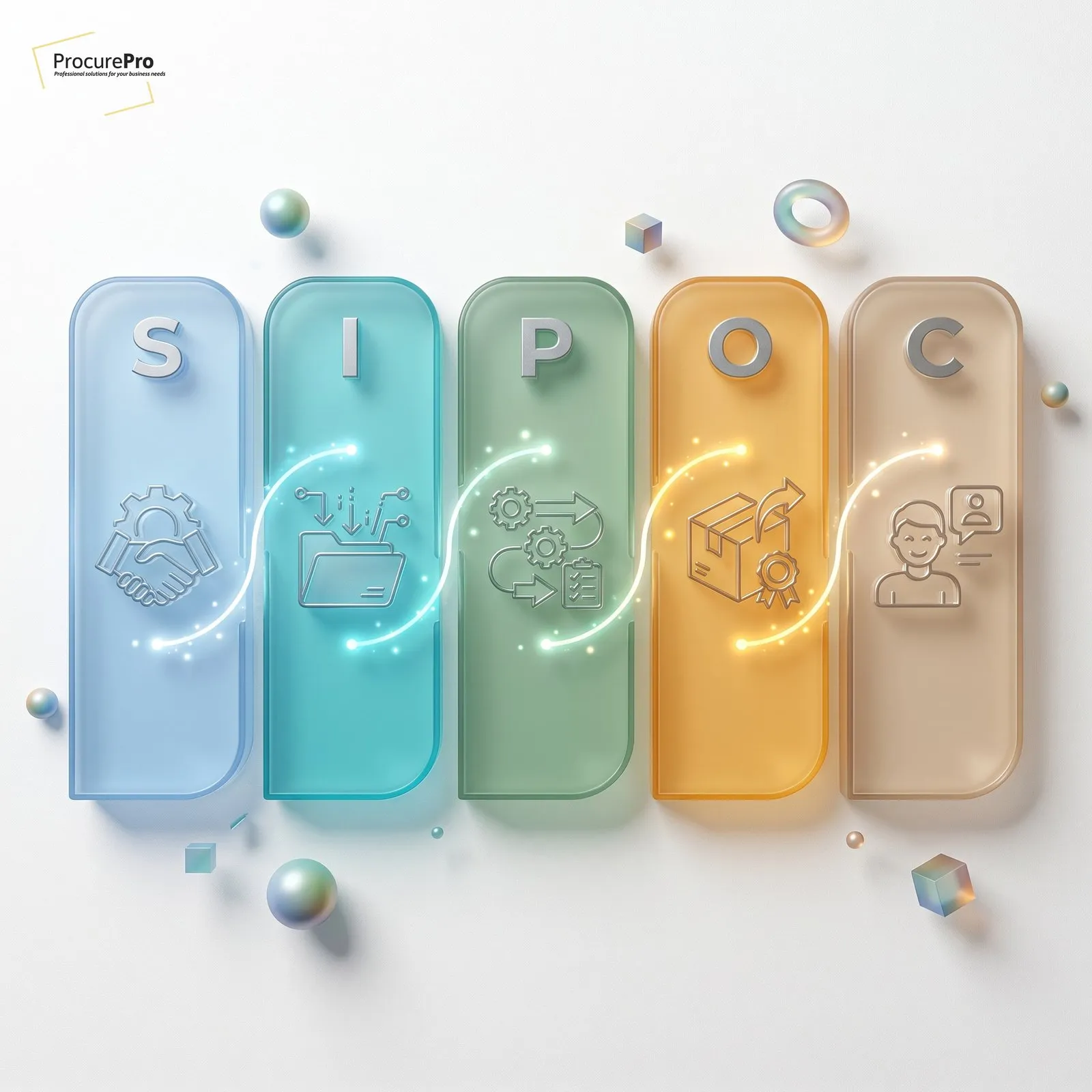
The name comes from the first letters of the five columns.
S: Suppliers. Who provides input to the process? It can be an external supplier, or another department.
I: Inputs. What does the process receive? Material, information, a request, a document.
P: Process. What does the process do with the input? Write five to seven main steps here. If you need more, split the process into sub-processes.
O: Outputs. What does the process produce? A product, a decision, a document, a report.
C: Customers. Who receives the output? An external customer, an internal department, or even the archive.
This is what a simple SIPOC for processing a purchase requisition looks like:
That is all. One page that shows anyone where the process starts, what happens in it and where it ends.
At the first project meeting, everyone brings the version that is in their own head. SIPOC gives a shared picture: within half an hour it becomes clear where participants agree and where they do not.
A new buyer sees on one page where the work comes from, what to do with it and who to pass it to. The detailed description comes later, but now there is something to anchor it to. At the end of onboarding, ask the new colleague what they missed from the SIPOC: you will learn a lot about the process from the answer.
The supplier and customer columns show who hands over the work and who takes it. Many disputes come from two departments having different ideas about where one’s task ends and the other’s begins.
If the process column has more than seven steps, the process is probably too complicated. The first goal then is to simplify, and only after that to automate. A complicated process stays complicated when automated.
Outputs have measurable properties: lead time, error count, accuracy. That is where the process metrics come from. We cover this in more detail in our article on the procurement KPI system.
Besides processing a requisition, a few other procurement processes fit SIPOC well:
Supplier onboarding. The suppliers here are the candidate company and the engineering department; the inputs are the supplier form, certificates and quality documents. The output is an approved supplier in the system, and the customers are procurement, finance and quality. A SIPOC usually shows quickly that quality and finance request the same data independently of each other.
Invoice matching and payment. The inputs are the purchase order, the goods receipt and the invoice. If the three do not match, the process stops. The SIPOC shows who is responsible for each input, and therefore where to start reducing errors.
Contract renewal. The inputs are the expiring contract, performance data and the internal need. The output is a new contract or a decision to re-tender. Here the SIPOC also reveals who is watching the expiry dates.
Too many steps. If the process column has fifteen rows, it is a flowchart, not a SIPOC.
Looking only from the inside. If nobody asks the customers, the output column shows what the process produces, not what is needed.
No fixed start and end point. If it is unclear where the process starts and ends, participants will each put something different in. Fix those two points first, in one sentence each.
Treating it as a final document. SIPOC does not close a piece of work. It starts one. Its job is to make sure everyone is talking about the same process before going into the details.
We often start our process development projects with a SIPOC, and carry the work on from there to the detailed process, the metrics and implementation. See our process development service, or request a free consultation.
The process owner, plus at least one person from each area that provides input or receives the output. Four to six participants are usually enough. If the process owner fills it in alone, the supplier and customer columns will reflect their own assumptions.
The process column, meaning the five to seven main steps. Once that is in place, it is easier to define what goes in and what comes out. Suppliers and customers come after that.
Five to seven steps, each a short phrase starting with a verb. If more steps are needed, split the process into sub-processes and build a separate SIPOC for each.
After any change that brings a new participant, input or output into the process, such as a new system or a reorganization. Without such a change, a quick yearly review is enough.
Myth or reality
Procurement negotiation is not an inborn talent but a learnable profession. What professional negotiators do differently, and how to develop your team.

Hackett Group's 2025 benchmark shows top procurement organizations run at lower cost and deliver more savings. What can your team take from it?

Problems and solutions
A faulty first delivery and a stopped production line. Six steps to supplier pre-qualification, from questionnaire to PPAP to contractual change control.
A free 30-minute call — then you decide. No sales process, no obligation.