


Myth or reality
Myth: anyone can negotiate with a supplier
Procurement negotiation is not an inborn talent but a learnable profession. What professional negotiators do differently, and how to develop your team.
19 October 2026 · 5 min read
Moving production closer is now a real decision, but it is not free. What recent data shows, what we see in the region, and what to plan for if you decide now.
ProcurePro 5 min read
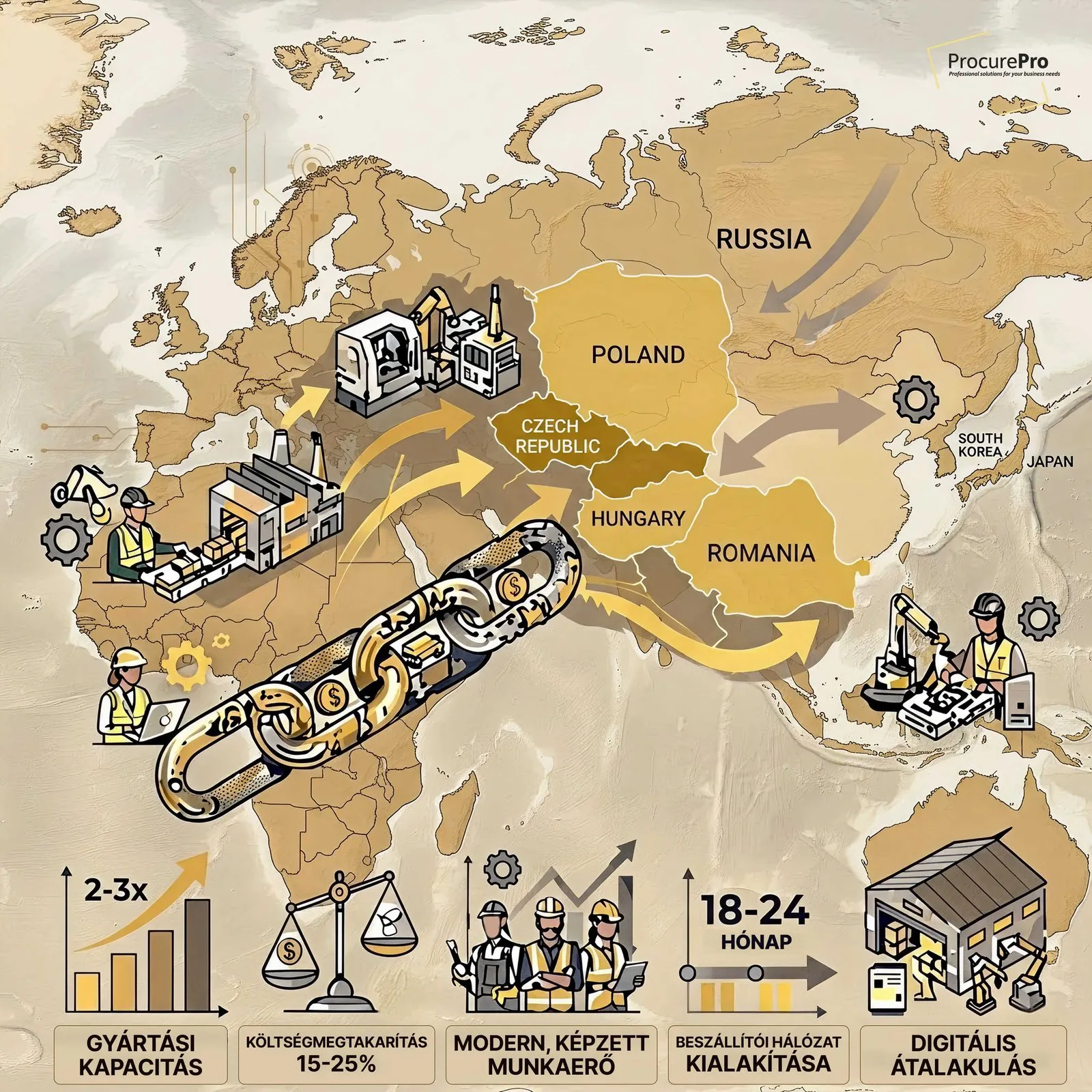
Five years ago nearshoring was mostly a conference topic. In 2026 it is a concrete decision about where the next plant goes and where the parts will come from.
Many of our clients are affected: manufacturers, automotive and machinery suppliers. In this article we sum up what recent data shows, what we see in the region, and what anyone deciding now should expect.
Capgemini’s reindustrialization report, published in April 2026, surveyed 1,208 executives at large companies in the US, the UK and continental Europe (France, Germany, Italy, the Netherlands, the Nordics and Spain). Among continental European companies it found:
According to the report, talent shortages are a constraint for a large majority of companies, most acutely in advanced manufacturing engineering, automation and digital skills.
Two things follow. First, companies have not given up on moving production, but they have become more selective. The report describes reindustrialization as entering a more selective, strategic phase: companies weigh more carefully where they move and why. Second, the main bottleneck is not capital but skilled labor.
From a Central European perspective this is tangible. Poland, the Czech Republic, Hungary and Romania have gained new plants and new supplier capacity in recent years. With that, pressure has grown on the labor market and on suppliers.
For a local supplier this is an opportunity: new customers, larger volumes. For a local manufacturer it is also a challenge, because it competes with the newcomers for the same specialists and the same supplier capacity.
What we hear from almost every client who takes it on:
If you decide on nearshoring now, plan for a go-live in 2027–2028, not next quarter. A deadline that is too short leads the company to pick the first available supplier, not the best one.
A good strategy is not “everything local”. For critical parts a nearby source reduces risk; for standard items available from many places, global sourcing is often still better. The Kraljic matrix helps decide which item belongs where.
The real winners will be those who do not just move production but rebuild their procurement and logistics processes along the way. A new site is a rare chance to start without old habits, with clean data and a modern system.
If you are a supplier, nearshoring can bring new customers, but only if your company is easy to choose. Manufacturers arriving in the region want to find qualified sources fast, and they pick the one with the least uncertainty.
A relocation succeeds or fails on how thoroughly the supplier market and the total cost are assessed up front. With 41 years of combined multinational procurement experience, we help assess the supplier base, qualify suppliers and manage the transition. See our procurement service, or request a free consultation.
Reshoring is when a company brings production back to its home country. Nearshoring is when it moves production to a nearby country, for example from Western to Central Europe. Friendshoring is when it locates production in countries with close political and economic ties.
In our experience, typically 18–24 months, not six. Finding suppliers, qualifying them, approving samples and ramping up series production happen step by step, and every step can slip.
No. For critical, high-risk parts a nearby source reduces risk. For standard items available from many places, global sourcing is often still cheaper, and its risk is manageable.
With an assessment of its current supply chain: which parts come from far away, how critical each one is, and what their total sourcing cost is including transport, duties and inventory. That shows where a switch pays off.
Myth or reality
Procurement negotiation is not an inborn talent but a learnable profession. What professional negotiators do differently, and how to develop your team.

Hackett Group's 2025 benchmark shows top procurement organizations run at lower cost and deliver more savings. What can your team take from it?

Problems and solutions
A faulty first delivery and a stopped production line. Six steps to supplier pre-qualification, from questionnaire to PPAP to contractual change control.
A free 30-minute call — then you decide. No sales process, no obligation.